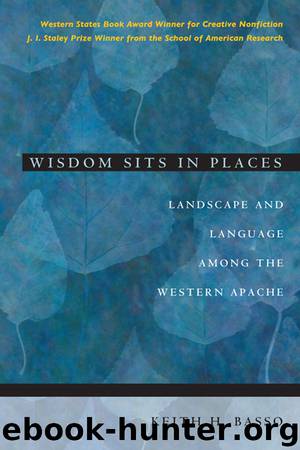
Wisdom Sits in Places: Landscape and Language Among the Western Apache by Keith H. Basso
Author:Keith H. Basso [Basso, Keith H.]
Language: eng
Format: mobi
Tags: Human Geography - Arizona - Philosophy, Western Apache Language, Western Apache Language - Discourse Analysis, Arizona, Geographical - Arizona, Native American Languages, Linguistics, Nature, Western Apache Language - Etymology - Names, Human Geography, General, Language Arts & Disciplines, Etymology, Names, Geographical, Foreign Language Study, Apache, Discourse Analysis, Apache Philosophy, Social Science
ISBN: 9780826317247
Publisher: University of New Mexico Press
Published: 1996-08-01T04:00:00+00:00
Western Apache conceptions of language and thought are cast in pervasively visual terms. Every occasion of ‘speaking’ (yałti’) provides tangible evidence of ‘thinking’ (natsíkęęs), and thinking occurs in the form of ‘pictures’ (be’elzaahí) that persons ‘see’ (yo’) in their minds. Prompted by a desire to ‘display thinking’ (nil’ natsíkęęs), speaking involves the use of language to ‘depict’ (’e’ele’) and ‘convey’ (yo’ááł) these images to the members of an audience, such that they, on ‘hearing’ (yidits’ag) and ‘holding’ (yot’) the speaker’s words, can ‘view’ (yínel’’) the images in their own minds. Thinking, as Apaches conceive of it, consists in picturing to oneself and attending privately to the pictures. Speaking consists in depicting one’s pictures for other people, who are thus invited to picture these depictions and respond to them with depictions of their own. Discourse, or ‘conversation’ (’iłch’’ yádaach’ilti’), consists in a running exchange of depicted pictures and pictured depictions, a reciprocal representation and visualization of the ongoing thoughts of participating speakers.
But things are not really so neat and tidy. According to consultants from Cibecue, the depictions offered by Western Apache speakers are invariably incomplete. Even the most gifted and proficient speakers contrive to leave things out, and small children, who have not yet learned to indulge in such contrivances, leave out many things. Consequently, Apache hearers must always ‘add on’ (’ínágodn’aah) to depictions made available to them in conversation, augmenting and supplementing these spoken images with images they fashion for themselves. This process is commonly likened to adding stones to a partially finished wall, or laying bricks upon the foundation of a house, because it is understood to involve a ‘piling up’ (łik’iyitł’ih) of new materials onto like materials already in place. It is also said to resemble the rounding up of livestock: the ‘bringing together’ (dalaházh’ch’indííł) of cattle or horses from scattered locations to a central place where other animals have been previously gathered. These metaphors all point to the same general idea, which is that depictions provided by Apache speakers are treated by Apache hearers as bases on which to build, as projects to complete, as invitations to exercise the imagination.
Western Apaches regard spoken conversation as a form of ‘voluntary cooperation’ (łich’’ ’odaach’idii) in which all participants are entitled to displays of ‘respect’ (yińłsh). Accordingly, whenever people speak in cordial and affable tones, considerations of ‘kindness and politeness’ (bił goch’oba’) come centrally into play. Such considerations may influence Apache speech in a multitude of ways, but none is more basic than the courtesy speakers display by refraining from ‘speaking too much’ (łgo yałti’). Although the effects of this injunction are most clearly evident in the spare verbal style employed by Apache storytellers, people from Cibecue insist that all forms of narration benefit from its application. And the reasons, they explain, are simple enough.
A person who speaks too much—someone who describes too busily, who supplies too many details, who repeats and qualifies too many times—presumes without warrant on the right of hearers to build freely and creatively on the speaker’s own depictions.
Download
This site does not store any files on its server. We only index and link to content provided by other sites. Please contact the content providers to delete copyright contents if any and email us, we'll remove relevant links or contents immediately.
| Anthropology | Archaeology |
| Philosophy | Politics & Government |
| Social Sciences | Sociology |
| Women's Studies |
Cecilia; Or, Memoirs of an Heiress — Volume 1 by Fanny Burney(32638)
The Great Music City by Andrea Baker(32610)
Cecilia; Or, Memoirs of an Heiress — Volume 2 by Fanny Burney(32013)
Cecilia; Or, Memoirs of an Heiress — Volume 3 by Fanny Burney(31997)
We're Going to Need More Wine by Gabrielle Union(19110)
All the Missing Girls by Megan Miranda(16326)
Pimp by Iceberg Slim(14678)
For the Love of Europe by Rick Steves(14587)
Bombshells: Glamour Girls of a Lifetime by Sullivan Steve(14138)
Norse Mythology by Gaiman Neil(13459)
Talking to Strangers by Malcolm Gladwell(13445)
Fifty Shades Freed by E L James(13293)
Mindhunter: Inside the FBI's Elite Serial Crime Unit by John E. Douglas & Mark Olshaker(9421)
Crazy Rich Asians by Kevin Kwan(9349)
The Lost Art of Listening by Michael P. Nichols(7551)
Enlightenment Now: The Case for Reason, Science, Humanism, and Progress by Steven Pinker(7356)
The Four Agreements by Don Miguel Ruiz(6837)
Bad Blood by John Carreyrou(6675)
Weapons of Math Destruction by Cathy O'Neil(6371)
